A GTM team adds an AI tool for call summaries.
Then another for outbound personalization. Another for enrichment. Another for forecasting. Another for routing. Another for customer health scoring.
Each tool looks reasonable in isolation. Each solves a problem someone actually has. Six months later, RevOps is holding the bag: duplicate fields, conflicting scores, Slack alerts nobody owns, dashboards that disagree, and reps switching between too many surfaces.
The failure was not buying bad tools.
The failure was buying tools before defining the operating environment.
Tool Sprawl Is Not A Procurement Problem
Tool sprawl is usually treated as a budget issue: too many licenses, too much overlap, too many unused seats.
That is real, but it is not the deepest issue. The deeper issue is context fragmentation.
Every GTM tool carries a partial view of the customer. CRM has ownership and opportunity stage. Sales engagement has sequence activity. Conversation intelligence has call content. Product analytics has usage. Support has complaints. Billing has renewal and payment. Enrichment has company and contact facts.
AI makes this worse if every tool adds its own intelligence layer.
Now you do not only have multiple systems. You have multiple systems making suggestions.
Which suggestion wins?
The Buying Rule
Before adding an AI GTM tool, ask one question:
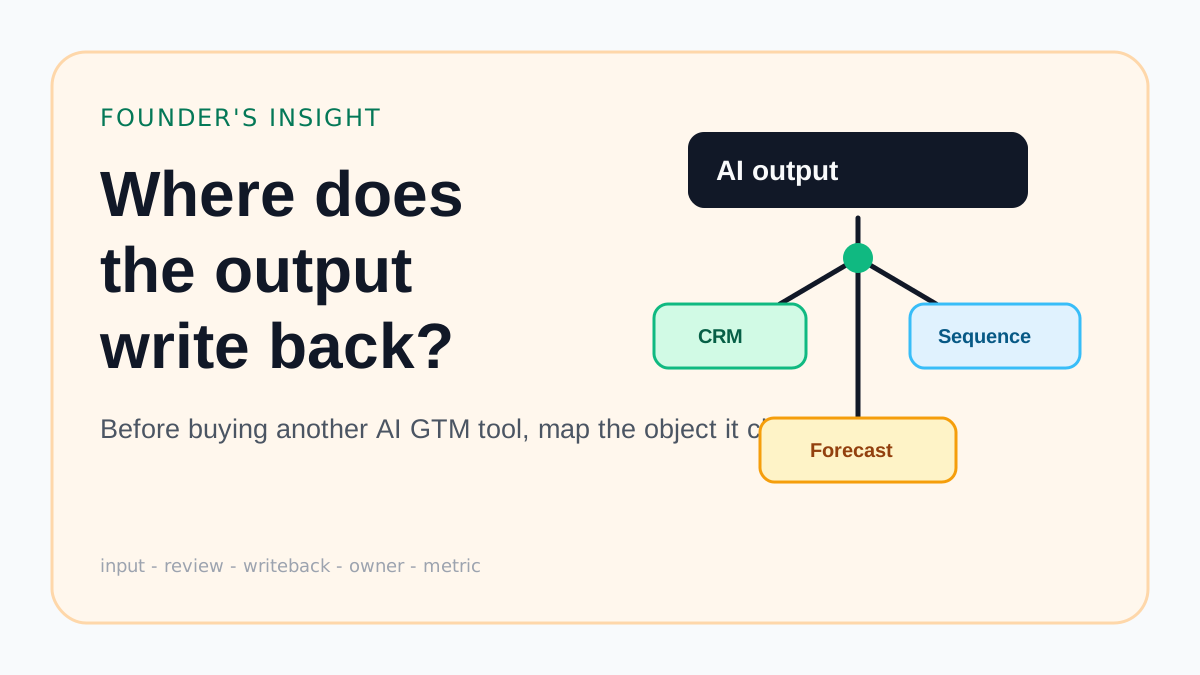
What object does this tool change?
If the answer is "it creates insights," that is not enough. Does it change a lead, contact, account, opportunity, forecast, campaign, sequence, health score, renewal plan, routing decision, or rep task?
If the tool changes nothing, it is a dashboard.
If it changes something but no one owns the result, it is risk.
If it changes something with no audit trail, it is a governance problem.
If it creates an action that no human trusts, it is noise.
System View
The evaluation workflow should be simple.
Input: current stack map, CRM fields, workflow owner, baseline metric, and data quality level.
AI step: identify what the candidate tool reads, what claim it makes, what action it suggests, what object it updates, and what evidence supports the suggestion.
Human review: RevOps or the workflow owner checks whether the tool duplicates existing capability, creates a new source of truth, requires new fields, needs approval, introduces risk, or will be trusted by reps.
Output: a CRM field, CRM note, task, Slack alert, sequence step, routing queue, forecast adjustment, health score, or playbook recommendation.
Metric: one operational measure, not "AI usage." For lead routing it might be routing failure rate or time-to-first-touch. For enrichment it might be field completeness or bounce rate. For outbound AI it might be positive reply rate or meeting-to-opportunity conversion.
What To Test Next
Before buying another AI GTM tool, run a stack audit.
Make a table with five columns: tool, workflow it supports, object it reads, object it writes, and metric it improves.
Then mark every tool: keep, consolidate, retire, or re-evaluate.
For every new AI tool, require a one-page implementation brief: real pain, data required, system of record, human review point, writeback object, failure mode, primary metric, and rollback plan.
If the team cannot fill that out, do not buy the tool yet.
The next GTM advantage will not come from having the most AI tools. It will come from having the clearest operating environment for AI to act inside.